

 In January 1989 General Motors introduced the SD60M. It was their first US locomotive to feature a comfort/safety cab, commonly called a "wide-cab" by railfans. Union Pacific took delivery of the first units, followed by Soo Line and Burlington Northern. All these units had the 3-window version. By the time Conrail placed their order in 1991 the SD60M was up to Phase III, with several changes having taken place, the most noticeable being the new 2-window cab with slanted roof for improved visibility.
Conrail began receiving their first SD60M's during December 1992, with the final order arriving sometime in March 1993. Pleased with the locomotives, Conrail placed another order for delivery between May and June 1993. All of Conrail's SD60M's were assigned to the series 5500-5574, except for 5544 which was an SD60I.
A powerful 4,000hp locomotive, Conrail's SD60M's had a speed limit of 70mph. All units were equipped with cab air conditioners (more for the new computers than the crew according to several CR employees), LSL for operating over the Northeast Corridor, wheel flange lubricators, a 5,000-gallon fuel tank, and factory-installed ditch lights (the first time for this option). The nose on all units was painted in an anti-slip black, which tended to wear off, revealing the blue paint beneath. All units were based at Enola, PA, for their 90-day inspections, but they could be found roaming the entire system and often on other railroads.
Features Unique to Conrail SD60M's
 Handrails: In order to cut down on engine vibrations reaching the crew, the long hood handrails on all Conrail SD60M's stopped just short of the cab wall. An extra, reinforced handrail (pictured to the right) was then added just a few inches in from the end of both railings. This was probably another way to cut down on vibrations as well as keeping the railing more stable.

Classification Lights: While other authors have claimed that all of Conrail's SD60M's were Phase III models, I have noticed that there were two "subclasses." The first subclass ran from 5500 to 5513. These locomotives had flush-mounted FRA- approved class lights on the nose and rear. The second subclass ran from 5514 to 5574 and had recessed FRA-approved class lights. Keep in mind that 5544 was an SD60I that was numbered in the middle of the SD60M series. The photo to the right shows the differences between the two types of class lights, with the recessed lights on the left and the flush-mounted lights on the right.
 Radiator Fans: The radiator fans on Conrail SD60M's were recessed about an inch below the hood. EMD held over this design from their SD70M units. Conrail was the only road with such fans on their SD60M's. To the right is a close-up photo of the three fans.
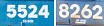 Cab Numbering: The font used for the road numbers on the SD60M was thicker or "heavier" than that used on prior CR locomotives. The locomotive model/class stencil was also larger. For example, in the photo to the right, compare the "2" in the SD60M on the left with the same "2" in the GP38-2's number to the right. This wide font seems to have been used on most if not all Conrail EMD locomotives built or repainted into the Quality scheme since the SD60M. (GE units seem to have had their own variations.) I haven't taken the time to see if this theory holds 100% true, but my spot checks seem to bear it out.
Comprehensive EMD SD60M Roster (Fully Revised: August 19, 2019)
The roster below is comprehensive for Conrail's SD60M between their arrival on Conrail starting in December 1992 and their last day of Conrail service on May 31, 1999. Nearly all Conrail's SD60M's were transferred to Norfolk Southern or CSX on June 1, 1999. The roster includes each unit's first disposition. A special thanks to Conrail The Final Years: 1992-1997 by Withers for completing the built dates and builder's numbers. Remember, CR 5544 was considered an SD60I, which is why it is excluded from this roster.
               Builder's
CR #   Built   Number      Removed    Disposition  Note
=======================================================
5500   12/92   916246-1    05/31/99   CSX 8756     1
5501   12/92   916246-2    05/31/99   NS 6763      1
5502   12/92   916246-3    05/31/99   CSX 8757     1
5503   12/92   916246-4    05/31/99   NS 6764      1
5504   12/92   916246-5    05/31/99   NS 6765      1
5505   12/92   916246-6    05/31/99   CSX 8758     1
5506   12/92   916246-7    05/31/99   NS 6766      1
5507   12/92   916246-8    05/31/99   NS 6767      1
5508   12/92   916246-9    05/31/99   CSX 8759     1
5509   12/92   916246-10   05/31/99   CSX 8760     1
5510   01/93   916246-11   05/31/99   NS 6768      1
5511   01/93   916246-12   05/31/99   CSX 8761     1
5512   01/93   916246-13   05/31/99   NS 6769      1
5513   01/93   916246-14   05/31/99   NS 6770      1
5514   01/93   916246-15   05/31/99   CSX 8762     2
5515   01/93   916246-16   05/31/99   NS 6771      2
5516   01/93   916246-17   05/31/99   CSX 8763     2
5517   01/93   916246-18   05/31/99   NS 6772      2
5518   01/93   916246-19   05/31/99   CSX 8764     2
5519   01/93   916246-20   05/31/99   NS 6773      2
5520   01/93   916246-21   05/31/99   NS 6774      2
5521   01/93   916246-22   05/31/99   CSX 8765     2
5522   01/93   916246-23   05/31/99   NS 6775      2
5523   01/93   916246-24   05/31/99   NS 6776      2
5524   02/93   916246-25   05/31/99   CSX 8766     2
5525   02/93   916246-26   05/31/99   CSX 8767     2
5526   02/93   916246-27   05/31/99   NS 6777      2
5527   02/93   916246-28   05/31/99   NS 6778      2
5528   02/93   916246-29   05/31/99   CSX 8768     2
5529   02/93   916246-30   05/31/99   NS 6779      2
5530   03/93   926330-1    05/31/99   NS 6780      2
5531   03/93   926330-2    05/31/99   NS 6781      2
5532   03/93   926330-3    05/31/99   NS 6782      2
5533   03/93   926330-4    05/31/99   NS 6783      2
5534   03/93   926330-5    05/31/99   CSX 8769     2
5535   03/93   926330-6    05/31/99   CSX 8770     2
5536   03/93   926330-7    05/31/99   CSX 8771     2
5537   03/93   926330-8    05/31/99   NS 6784      2
5538   03/93   926330-9    05/31/99   NS 6785      2
5539   03/93   926330-10   05/31/99   NS 6786      2
5540   03/93   926330-11   05/31/99   CSX 8772     2
5541   03/93   926330-12   05/31/99   NS 6787      2
5542   03/93   926330-13   05/31/99   NS 6788      2
5543   03/93   926330-14   05/31/99   CSX 8773     2
5545   04/93   936400-1    05/31/99   CSX 8775     2
5546   04/93   936400-2    05/31/99   NS 6789      2
5547   04/93   936400-3    05/31/99   CSX 8776     2
5548   04/93   936400-4    05/31/99   NS 6790      2
5549   04/93   936400-5    05/31/99   CSX 8777     2
5550   04/93   936400-6    05/31/99   NS 6791      2
5551   04/93   936400-7    05/31/99   CSX 8778     2
5552   04/93   936400-8    05/31/99   NS 6792      2
5553   05/93   936400-9    05/31/99   NS 6793      2
5554   05/93   936400-10   05/31/99   NS 6794      2
5555   05/93   936400-11   05/31/99   CSX 8779     2
5556   05/93   936400-12   05/31/99   CSX 8780     2
5557   05/93   936400-13   05/31/99   NS 6795      2
5558   05/93   936400-14   05/31/99   NS 6796      2
5559   05/93   936400-15   05/31/99   NS 6797      2
5560   05/93   936400-16   05/31/99   NS 6798      2
5561   05/93   936400-17   05/31/99   CSX 8781     2
5562   06/93   936400-18   05/31/99   CSX 8782     2
5563   06/93   936400-19   05/31/99   NS 6799      2
5564   06/93   936400-20   05/31/99   NS 6800      2
5565   06/93   936400-21   05/31/99   NS 6801      2
5566   06/93   936400-22   05/31/99   CSX 8783     2
5567   06/93   936400-23   05/31/99   CSX 8784     2
5568   06/93   936400-24   05/31/99   NS 6802      2
5569   06/93   936400-25   05/31/99   CSX 8785     2
5570   06/93   936400-26   05/31/99   NS 6803      2
5571   06/93   936400-27   05/31/99   NS 6804      2
5572   06/93   936400-28   05/31/99   NS 6805      2
5573   06/93   936400-29   05/31/99   CSX 8786     2
5574   06/93   936400-30   05/31/99   NS 6806      2
Roster Notes:
1. CR 5500 through CR 5513 had flush-mounted classification lights.
2. CR 5514 through CR 5574 had recessed FRA classification lights.